“Much is said nowadays around the negative connotations of being under pressure. However, with a little application of knowledge it can also be a key enabler for us to be the best we can be. This is not just a text for how we perform at work, but a key insight in how we can perform in life, in teams and as individuals when leading others and ourselves.”
Paul Gowens QAM FCPara DipIMC, Lead Consultant Paramedic, Scottish Ambulance Service
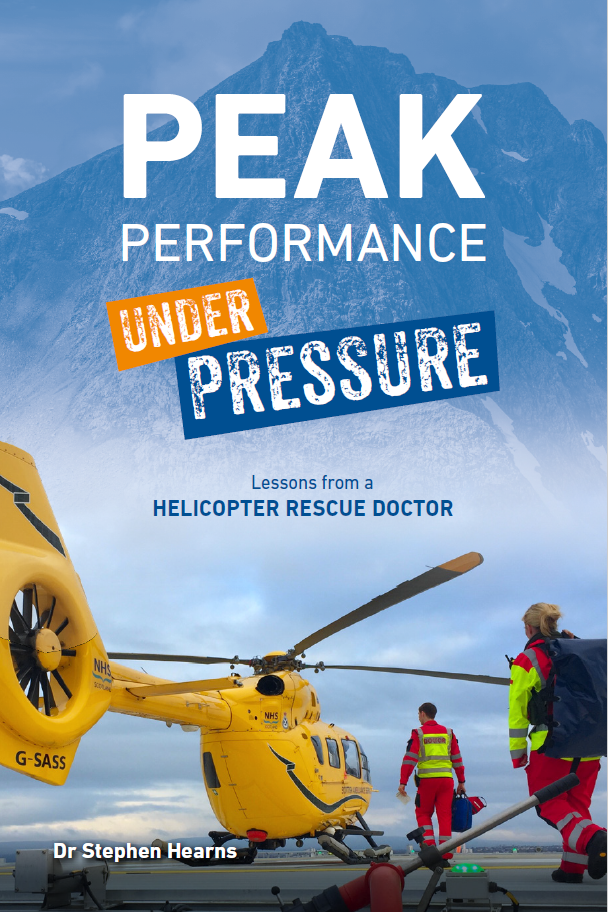
You can now get your hands on this newly published book, written by Dr Stephen Hearns, a consultant in emergency and helicopter retrieval medicine, which is all about performance in high pressure situations and creating high performance teams.
Peak Performance features interviews ranging from military personnel to search and rescue professionals including pilots. The book also draws upon the author’s 20 years of leadership experiences in helicopter medicine, EM, medicolegal work and mountain rescue, focusing on the times when he has been under a significant amount of pressure and has needed to perform to a high standard.
The book discusses the psychology of pressure and how, instead of allowing it to affect us negatively, we can harness it to achieve ‘Peak Performance’.
It is based on a unique model of ‘Owning the Pressure’, set out in the following clear sections that correspond to each step:
• The Pressure Pump is your organisation’s culture, leadership and selection processes
• Pressure Testing is how we train and prepare ourselves for high performance – drilling, simulation, stress inoculation, teamwork and communication
• Pressure Control is all about cognitive aids, checklists and equipment management
• Pressure relief valves are the tools we can use to regain situational control and personal composure.
Peak Performance is now available to purchase from our website with a 30% discount when you use code PEAK30 at the checkout. Visit www.classprofessional.co.uk for more information.
Time to put
on your best Frank Sinatra voice – “It’s the most wonderful time of the year!”
Nope, we’re not talking about Christmas; we’re talking about September, as it was time to return to Birmingham for the Emergency Services Show, undoubtedly the biggest conference event in our calendar and fair to say our best ESS yet!
Our time in the Midlands began on Tuesday as the team clubbed together to set up the stand, fashioning some on-brand Hi-Vis jackets – the luminous yellow a stark contrast to our usual office attire! We were also delighted to be joined by Alison & Janet from Jones & Bartlett Learning for the event, our US colleagues whom we represent throughout Europe.
The morning of the show quickly came around and the team eagerly waited in their ‘Are You Following Me?’ Twitter tees as the doors opened to the 4,000 delegates expected to attend the first day. Within minutes, the first group of people came over to the stand and headed straight for the gleaming JRCALC 2019 Guidelines – it was finally time to ditch the well-thumbed 2016 editions!
Before we knew it, the clock struck 10:30 – the launch of the new second edition of Ambulance Care Essentials & Ambulance Care Practice. AACE Chief Executive Steve Irving opened the launch, followed by a few words from authors Richard Pilbery and Kris Lethbridge and some celebratory shortbreads to hand. We were thrilled to see so many people stopping by especially for the launch, including those who modelled in the photo shoots.
The great thing about the Emergency Services Show is the sheer volume of the event; so many interesting stands to visit, not to mention the West Midlands Fire Service Extrication Challenge and Trauma Challenge, hosted by Class author Simon Todd with the UK Research Organisation. A few of the team even managed a sneaky five-minute break from our stand to visit the Ortis Fest bar!
Day two of the event certainly didn’t disappoint as there wasn’t a moment where the stand was empty! By early afternoon, we had sold out of all 200 copies of the JRCALC pocket books and our eco-friendly tote bags had all been dispersed amongst the NEC. It was also great that our human, and non-human, friends took selfies for our #StrikeAPose Twitter competition, where they could be in with a chance with winning a year’s membership to our new CPD app Paramedic Passport (ParaPass), coming later this year.
The stand
was still packed within the last hour of the show, with some popping over not
necessarily to buy but just to say hi – always a delight to put a face to a
name!
As the doors to Hall 5 closed for another year, we were left feeling overwhelmed with joy as, in the number of years we’ve exhibited at ESS, our sales record had been broken! We can’t wait to do it all over again next year, building new relationships and launching more books and products.
August. For most of us here in the UK, it’s the time of year where we think about sun, sea, BBQs and laughter with friends. For others, it can only mean one thing – *cue dramatic music* – A Level Results Day.
We hope you’ve got the results you need to embark on your journey to becoming a Paramedic, it’s just a shame that it involves more studying and a *few* more textbooks. You’re probably thinking, ‘Great, I’ve finished A-Levels but now there’s more stress, studying and endless textbooks to come. Why?!’, but take it from us two graduates, it will all be worth it.
We have a helpful introduction on some of the reading materials you might need and what you could expect whilst studying as an undergraduate. And for those reading this who have already battled through their first or second year (congrats!) but aren’t sure where to look for their next academic term, we’ve got you covered too.
Year 1
Freshers’ week is over. It’s time for the real work to
start, but don’t worry, you won’t be expected to drive an ambulance at 50mph
just yet.
You’ll begin to understand the foundations and theories of
paramedic science and how to apply this to your clinical practice. With the
perfect mixture of interpersonal and academic skills, you’ll feel prepared for
your first placement in no time. To help you achieve this, here’s what texts
we’d recommend for making the most of your formative first year.
Like a dog’s not just for Christmas, JRCALC isn’t just for
university – it’s for life.
The Joint Royal Colleges Ambulance Liaison Committee Guidelines
are the essential resource for Paramedics. JRCALC combines expert advice with
practical guidance to help Paramedics in their challenging roles and supports
them in providing patient care. The book covers a wide range of topics, from
resuscitation, medical emergencies, trauma, obstetrics and medicines to major
incidents and staff wellbeing.
From an emergency call to end of life care, this textbook is
an essential guide for paramedic students. It provides a complete overview of
the key skills, knowledge and understanding required to work at ambulance
associate practitioner level or similar within the ambulance service, covering theoretical
aspects and practical application, as well as a range of different clinical
procedures and patient populations. Chapters include communication, mental
health, patient assessment and safeguarding.
As this is such a key topic in the Paramedic Science degree
programme, we have two textbooks for you – one for theory, one for practice.
The Anatomy & Physiology for Health Professionals features
a total of six multifaceted ‘Units’ which build upon an understanding of basic
knowledge, take readers through intermediate subjects, and finally delve into
complex topics that stimulate critical thinking.
UK Edited Anatomy & Physiology Work Book includes colouring
and labelling activities along with self-assessment tests for virtually every
structure of the human body. It offers paramedic students a better
understanding of anatomy and physiology with the view that this will help
inform their practice and provide the best quality of care for their patients
as healthcare professionals.
Currently on sale for £13.50, the Paramedic Pocket Guide will be an essential resource for you as it features common drug sections, advanced life support, trauma and updated paediatric medications.
Year 2
It’s already the start of the new academic year, which means you’re a third of the way there. Woohoo!
This year, you’ll build your knowledge and confidence, expand your decision making and develop your clinical assessment skills. There will be a few tough hurdles along the way, such as understanding ECGs and preparing for an emergency birth scenario, not to mention the daunting world of ethics and legislation. Hey, it’s a good thing we’re a paramedic publisher who covers those exact topics…
This book offers a wealth of knowledge about the importance
of decision making in healthcare practice to reduce clinical risk and improve
outcomes for patients. The text explores the role of the modern paramedic and
of the paramedic as a critical thinker. It offers a unique perspective on
clinical decision making, highlighting important aspects such as the balance
between intuition and experience as well as professional issues.
This all-encompassing, four-colour text is designed to make you a fully advanced interpreter of ECGs. Level 1 provides basic information for those with minimal experience interpreting ECGs. Level 2 provides intermediate information for those with a basic understanding of the principles of electrocardiography. Level 3 provides advanced information for those with some mastery of the subject. The entire text is written in a friendly, easy-to-read tone. Additionally, the text contains real-life, full-size ECG strips that are integrated throughout the text and analysed in conjunction with the concepts they illustrate.
Childbirth – not only a life-changing experience for the
mother, but also for you as a Paramedic in an emergency situation; this book is
designed to make it a little less daunting. It will be an essential resource
for you as a Paramedic, should you come into contact with emergency birth. The
book has been specifically adapted from the official JRCALC Guidelines, the
established standard for pre-hospital care. For this unique publication, many
topics have been expanded upon, including Maternal Resuscitation, Umbilical
Cord Prolapse, Shoulder Dystocia and Post-partum Haemorrhage.
Written by paramedics, for paramedics, it includes chapters on information governance, mental capacity, clinical negligence and medical research, with a specific focus on legislation and case law across the United Kingdom. Practical top tips are outlined in chapters focusing on paramedic use of social media, gaining consent and the assessment and treatment of children. Realistic case studies prompt the reader to consider the legislation relating to mental health, medicines management as well as palliative and end of life care.
Year 3
You’re almost at the finishing line! Time to splash out on a celebratory pint… and a few more textbooks.
Exploring complex fields of paramedic practice, your final year will entail more clinical assessments and decision making, as well as recognising the leader in yourself. Freshers feels like yesterday, but that timid student has long gone since you now have the confidence in your acquired skills which will inspire and enable the learning of others.
Designed to serve as both an introductory resource as well
as a text which may support your existing knowledge, Practice Education
in Paramedic Science is a clear and easy-to-use guide for would-be registered
paramedics hoping to become practice educators as well as those already taking
on board the practice educator role. While this is something you might use more
post-university, it’s important to have a sound understanding of the practice
educator role within the paramedic profession, as many universities include
modules on practice education within their degree programme.
This UK localised edition continues the PHTLS mission
to promote excellence in trauma patient management by all clinicians
involved in the delivery of prehospital care through global education. PHTLS promotes
critical thinking as the foundation for providing quality care. It is based on
the beliefthat prehospital clinicians make the best decisions on
behalf oftheir patients when given a solid foundation of knowledge
and keyprinciples to fuel their critical-thinking skills.
Paediatric Education for Prehospital Professionals (PEPP) is the leading training course on the care of children in emergency and community settings written by the American Academy of Pediatrics. In the first ever United Kingdom edition, the book has been expanded and brought in line with guidance from the Joint Royal Colleges Ambulance Liaison Authority, National Institute for Health and Care Excellence, Resuscitation Council UK.
We know students can struggle with their pennies, so we contacted universities to give you guys 20% off when buying through our website. Simply contact your lecturer/department to get your code!
And of course, these aren’t all the textbooks we offer; there’s a whole host of titles for you to explore on our website as well as our apps, including ParaPass, a new CPD app launching early Autumn.
You can keep up to date with all our latest news, projects and giveaways by following us on Twitter, Instagram and Facebook. We also attend plenty of shows and events throughout the year where we offer special discounts and goodies – our tote bags for all your new books and a Tea/Coffee Withdrawal Guidelines mug will be just the thing you need to help you through your journey.
There may be copious amounts of caffeine, but we know you can do it!
Last month, some of the Class team headed North to sunny Newcastle for the College of Paramedics National Conference.
Delegates geared up for the conference by partaking in early morning yoga and running sessions; of course, we did quite the opposite by prepping celebratory shortbreads ahead of the launch of PHTLS UK ninth edition and Law & Ethics. It wouldn’t have been a book launch without a yummy Class snack!
The morning saw the launch of PHTLS UK. Supported by the College, it brings the renowned NAEMT PHTLS programme in line with UK practice paving the way for future courses and improved practice for paramedics. Will Broughton, UK Editor-in-Chief of PHTLS UK, presented the launch, thanking all the contributors:
“Our commitment to developing a lot of continuing professional development and continuing education for paramedics across the UK to make sure we’ve got the most up to date education materials that we can.”
Like the biscuits, the books were gone in a flash. It was such a rewarding feeling to have the response we did, or ‘do’ even now just under a month after publication!
The second launch of the day was for Law and Ethics for Paramedics, a contributed volume which fills the gap in the paramedic science literature. Editor Georgette Eaton spoke at the launch:
“Written by paramedics, for paramedics, this book talks about information governance and goes into legislation for mental health, mental capacity and medical research. It’s been a really exciting thing to be involved in; I’m really proud of all the voices we’ve got.”
Again, both books and biscuits disappeared before our eyes. It was great to have such a buzz around our stand and the new titles, with some even taking their excitement to Twitter!
The team then glammed up for the evening ahead of the Gala dinner – a remarkable celebration in recognising individuals from the Ambulance community, including Graham Harris who received the Lifetime Achievement award. As always, the College were superb in organising lovely food and drinks for us all.
The following day, we were lucky enough to sit in on the Live Birth simulation. Class authors, Aimee Yarrington and Amanda Mansfield, enacted two different scenarios to highlight issues of multi-professional team working, provoking important questions about communication, teamwork and leadership.
Lorna and Josie then stayed in Geordieland for the NAEMT meeting. Representatives from seventeen countries all attended, with insightful presentations from Will Broughton on EMS, and new trauma innovation from the UK by Gordon Ingram, HEMS Paramedic and Andy Mawson, Director of Operations from Great North Air Ambulance. Attendees expressed how interesting it was to see how things are done in the UK and how advanced our paramedics are! Nevertheless, it was great to also hear how different countries can now provide NAEMT courses and where there is potential for other countries to start.
Our time in the North was a fantastic opportunity to not only make sales, but once again engage with such inspirational and compassionate people. We had someone describe us as the Paramedics’ Publisher, something which left a huge grin on all our faces that not even the flight delay or the seven-hour car journey home could wipe away.
Here’s to the 2020 conference and more photo-bombs from Gary Strong!
On 26-28 April, Lorna Downing and Josie Brown attended EMS2019 Madrid, a 3-day conference where 950 people from 33 countries came together to hear about the latest knowledge and innovation in pre-hospital care.
The weekend consisted of an array of innovative technological and simulation-based workshops, not to mention the striking uniforms, including the familiar bottle-green of the UK! Different ambulance services from various countries entered the EMS Championships where they competed in heats to demonstrate their invaluable skills in emergency care, while speakers from around the world presented cutting-edge research. There was certainly a buzz among delegates who could take part in CPR challenges and test out ground-breaking medical technology.
The Saturday afternoon concluded with the Great Catastrophe Drill where gunshots sounded and actors fell as wounded casualties. The paramedic teams were quick to get involved, showing us first-hand their crucial service to societies on an international scale.
The EMS Championships were concluded on Sunday morning where a team from Germany, Austria and Denmark battled it out for the title. The team from Copenhagen took first place and a Eurovision style award ceremony was a brilliant way to conclude this years’ conference.
EMS2020 will take place in Scotland which Class Publishing are already excited for, especially if there are bagpipes to serenade us like the Spanish Mariachi band this year!
On Saturday 10th November we exhibited at the College of Paramedics’ annual event, the UK Student Paramedic Conference.
Our office situates in the small town of Bridgwater, so feeling homesick at the sight of city centre traffic (whilst in a van – even better) is almost a guarantee when travelling to conferences.
This year we ventured to Birmingham, and whilst the 6 a.m. wake-up call was a bit of a struggle, the success of the day and fantastic organisation by the College made it more than worthwhile. The patatas bravas were an added bonus!
Students were keen to know about our stuff, including new books like Emergency Birth in the Community (author Amanda Mansfield was a speaker at the event) and popular titles like the J&B Paramedic Field Guide – the bible of diagrams.
It’s always great to make a sale, but the more important aspect of exhibiting means we can have a good natter with the delegates. We loved hearing of our books being used during placements, along with feedback on our iCPG app and what they felt to be missing in the market of paramedic practice.
And that’s what’s so fulfilling about attending these events; whether they’re students or five years post-qualification, it’s great to be face to face with those who give so much to our society, and to gain a small insight into life as Paramedic.
P.S. – Look out for Emily as she’s featured in the College’s upcoming promo video





 Class Professional Publishing Blog